

Engineering Services
API Integration Engineering for Systems That Need to Actually Agree With Each Other.
We design and build secure, reliable integrations between WordPress, WooCommerce and the external systems your business depends on — CRMs, ERPs, payment gateways, shipping and 3PL providers and marketing platforms — engineered to handle failure, not just the happy path.
The Problems We Solve
Engineering Solutions for Complex API Integrations Challenges.
Every integration demo looks the same: two systems, a clean API call, a green checkmark. Real integrations spend most of their engineering effort on what happens when that call times out, when the two systems briefly disagree, or when a webhook arrives twice. The ten problems below are what actually determines whether an integration survives contact with production.
-
Data Synchronisation Issues
Two systems both claiming to hold the current, correct version of the same record — until one lags behind and a decision gets made on stale data.
-
Authentication Failures
Expired OAuth tokens, rotated API keys, and inconsistent credential handling — the quiet failure mode that stops an integration working with no obvious error message.
-
Rate Limiting Problems
An integration that works perfectly in testing and then gets throttled or blocked the moment real traffic hits the external API's actual usage limits.
-
Webhook Reliability
Webhooks that arrive out of order, arrive twice, or don't arrive at all — and an integration with no defence against any of those three cases.
-
Data Mapping Complexity
Two systems that both have a field called "status," meaning two entirely different things — the unglamorous mapping work that determines whether an integration is actually correct.
-
Legacy System Connections
Older platforms with undocumented or inconsistent APIs — sometimes no real API at all — that still need to connect to WordPress reliably.
-
Real-Time vs. Batch Sync
Choosing — and correctly implementing — whether a given integration needs instant, real-time sync or a scheduled batch process, and building the right one instead of defaulting to whichever is easier.
-
Error Handling & Recovery
An integration that fails silently is worse than one that fails loudly — every connection needs a real strategy for retries, alerting and manual recovery when something breaks.
-
Multi-Platform Coordination
Three or more systems that all need to stay consistent with each other simultaneously — where the integration logic has to account for every pair of systems disagreeing, not just one.
-
API Documentation Gaps
Third-party API documentation that's incomplete, outdated, or simply wrong — requiring real testing against the live API to determine actual behaviour before building against it.
What We Do
Our API Integrations Services.
Integration work spans a wide range of technical shapes — a single webhook receiver is a very different engineering problem from a bidirectional, multi-system sync running on a schedule. The ten services below cover the integration work we take on most often.
-
CRM Integrations
Reliable, tested connections between WordPress or WooCommerce and the CRM your sales and support teams already use, with error handling for the moments the two systems disagree.
-
ERP Integrations
Order, inventory and customer data flowing correctly between WooCommerce and the ERP your operations team runs on, without turning every deploy into a risk to that data flow.
-
Payment Gateway Integrations
Direct gateway integrations built against WooCommerce's payment-token and order-status architecture, with proper handling for failed transactions and webhook reliability.
-
Shipping & 3PL Integrations
Rate calculation, label generation and tracking sync with your shipping providers, plus order hand-off and stock updates with your 3PL or warehouse.
-
Marketing Platform Integrations
Customer and order data flowing correctly into the email and marketing automation platforms your growth team relies on, with the right events firing at the right time.
-
Custom REST API Development
Secure, documented REST endpoints that expose exactly what your systems need to share — nothing over-exposed, nothing left undocumented.
-
Webhook Systems
Webhook receivers built with idempotency, ordering and retry handling from the start — not a raw endpoint that assumes every request arrives exactly once, in order.
-
OAuth2 & Secure Authentication
Properly implemented OAuth2 flows and credential management — token refresh, secure storage, and scoped access instead of a single long-lived API key handling everything.
-
Legacy System Connectors
Custom-built bridges for older or non-standard platforms with limited or undocumented APIs, reverse-engineered and tested safely against the live system.
-
Integration Monitoring & Support
Ongoing monitoring and alerting for live integrations, so a broken connection is caught and fixed before it becomes a business problem, not after.
Featured Case Studies
Real API Integrations Engagements.
Real integration engagements pulled directly from our Case Studies system — multi-API connector suites and logic-driven systems built to sync correctly with the external platforms each business depends on.
-
Built From Scratch Agencies / SaaS
Logic-Driven Form Builder Engine
A drag-and-drop WordPress form builder plugin built from scratch, with conditional logic and direct CRM integration — not a page-builder add-on.
Read Case Study -
Multi-API Agencies / Multi-Platform
Third-Party API Integration Suite
REST, SOAP, and OAuth2 integrations unified in one WordPress ecosystem, connecting a store to the CRMs, ERPs, and platforms it already depended on.
Result: Three separate, manually-reconciled systems unified into one integration layer
Read Case Study
Our Engineering Process
How We Deliver.
Integration projects fail most often at the boundary nobody tested — the case where the external API returns something the documentation didn't mention. Our process is built specifically to surface those edge cases during architecture and testing, not after go-live.
Discovery
Mapping exactly which systems need to talk to each other, what data needs to move, and how each API actually behaves in practice.
Architecture
A real integration plan — data mapping, sync direction, error handling and edge cases documented before development starts.
Development
Building the integration against the agreed architecture, with regular checkpoints against the real external API, not a mocked one.
Testing
Tested against real failure scenarios — timeouts, rate limits, malformed responses — not just the happy path a demo would show.
Deployment
A supported go-live with monitoring in place from day one, so a failure is caught immediately rather than discovered days later.
Support
Ongoing monitoring and maintenance as both connected systems continue to change their own APIs over time.
How We Work
Follow the data. Harden each hop.
Data in an integration passes through the same hops. We look at each one, find where it fails, then build for that hop. Select a hop to see what we do.
Authentication
What goes wrong
Expired OAuth tokens and rotated keys that stop the connection with no clear error.
What we do
Implement OAuth2 with token refresh, secure credential storage and scoped access.
Tools we use here
- OAuth2
- REST API
Webhooks and requests
What goes wrong
Webhooks that arrive twice, late or out of order, and calls that hit rate limits.
What we do
Build receivers for idempotency, ordering and retries, and respect the external API's limits.
Tools we use here
- Webhooks
- Queues
Mapping and logic
What goes wrong
Fields that look the same but mean different things in each system.
What we do
Map fields explicitly, test against real records, and decide where real-time or batch sync fits.
Tools we use here
- PHP
- MySQL
- WooCommerce
The other system
What goes wrong
CRM, ERP, payment, shipping or 3PL platforms with limits and quirks of their own.
What we do
Build and test against the live system, including older platforms with weak APIs.
Tools we use here
- CRM Platforms
- ERP Systems
- Stripe
- PayPal
- Shipping APIs
Monitoring
What goes wrong
A failed sync that nobody notices until a customer or a team member does.
What we do
Add logging, retries and alerts so failures are seen and recoverable.
Tools we use here
- Logging & Monitoring
- Git
- Cloudflare
How we check it holds up. Test runs against real records, forced failures (expired token, repeated webhook, slow API) and alerts confirmed to arrive before launch.
Related Engineering Articles
From the Engineering Journal.
Why WooCommerce Integrations Fail, and How to Build Them to Last
Most WooCommerce integrations work in the demo and fail in production. The common causes, and what to build…
How Agencies Can Standardise WooCommerce Store Health Reviews
A simple, repeatable process for reviewing every client WooCommerce store the same way: the checks, the record, the…
How to Choose a WooCommerce Developer: Questions to Ask and Warning Signs
How to choose a WooCommerce developer without relying on a portfolio alone: the questions that show how they…
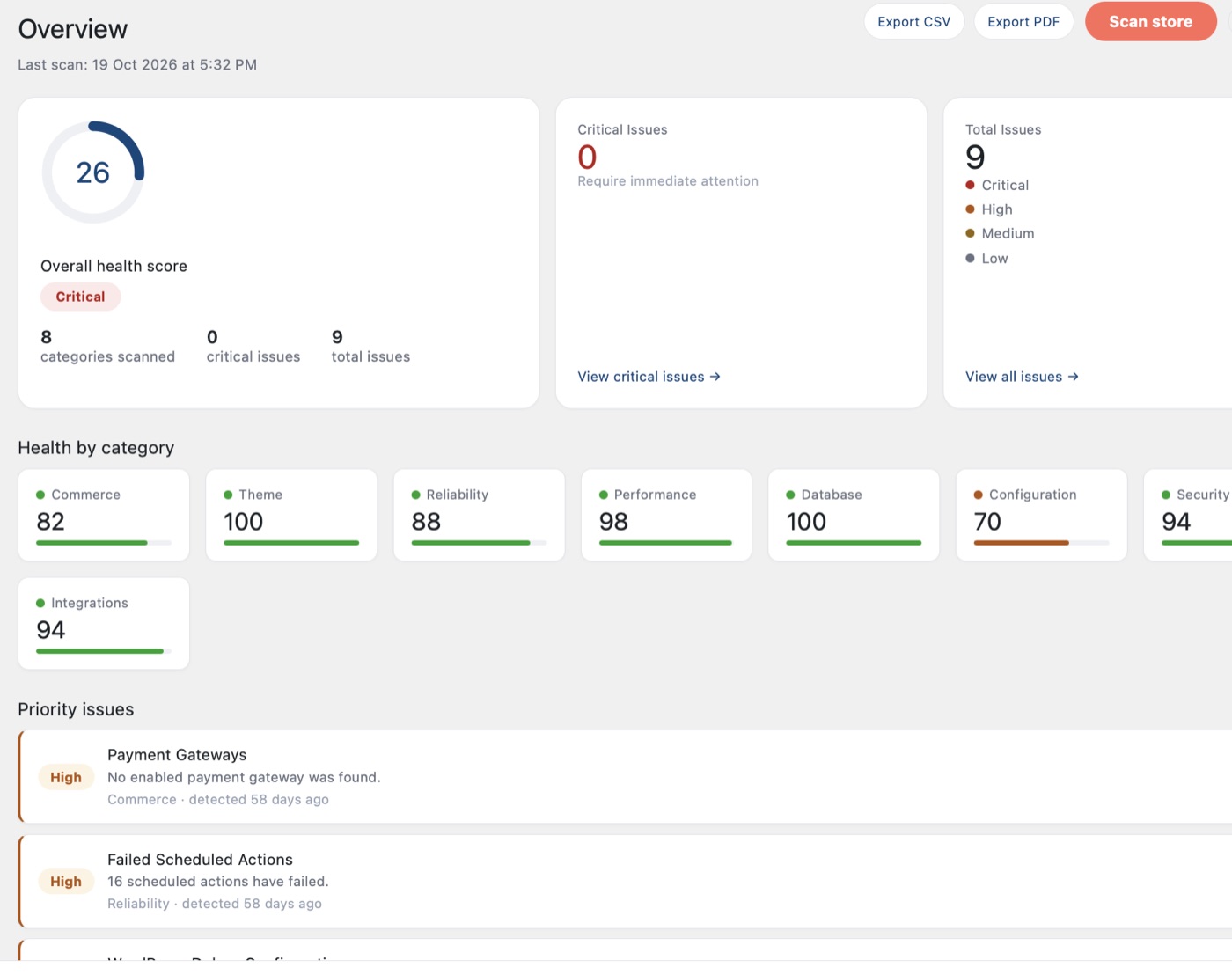
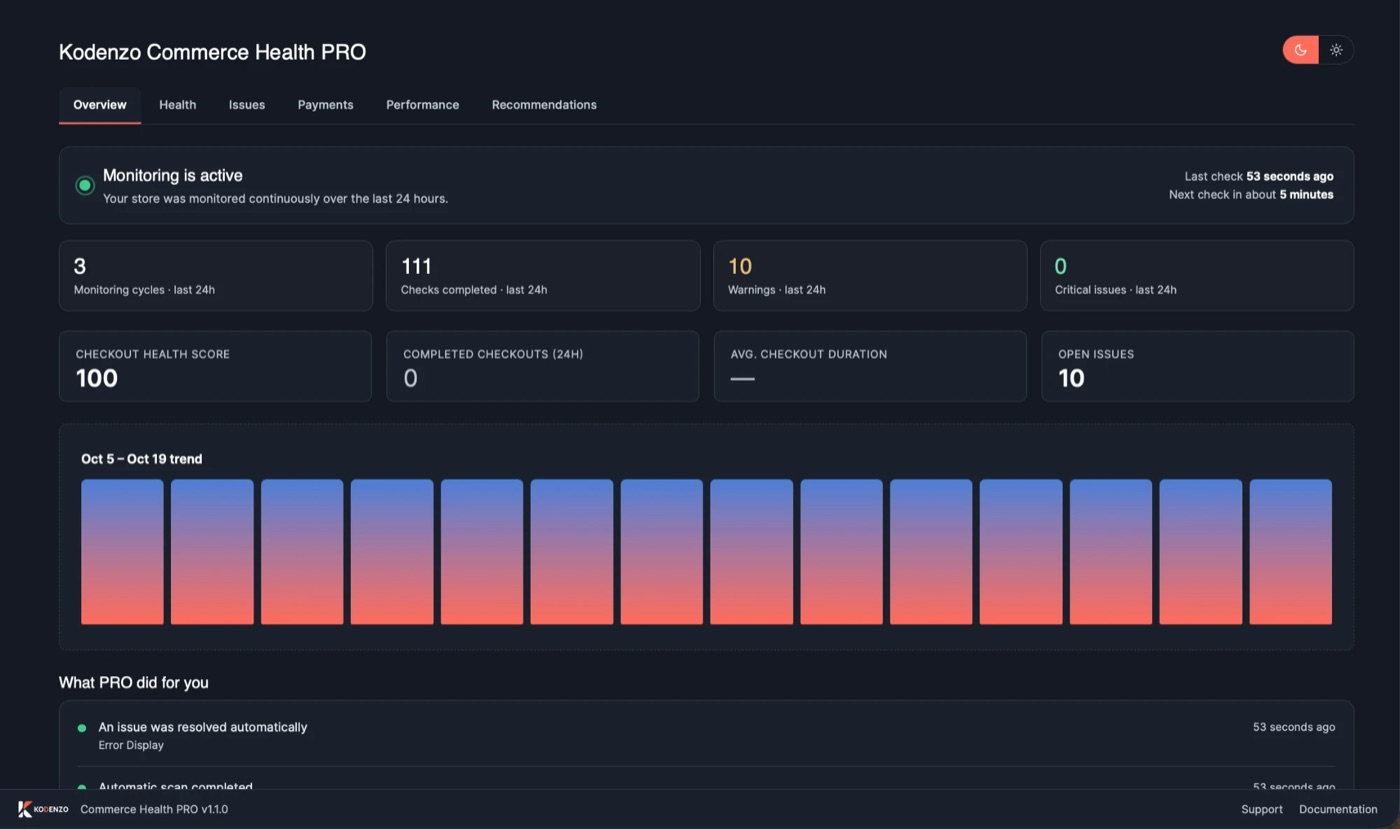
KODENZO Commerce Health
Is your store as fast and healthy as you think?
Find out in a few minutes, free. Then let PRO watch checkout for you in the background.
- Read-only checks across configuration, cache, database and updates
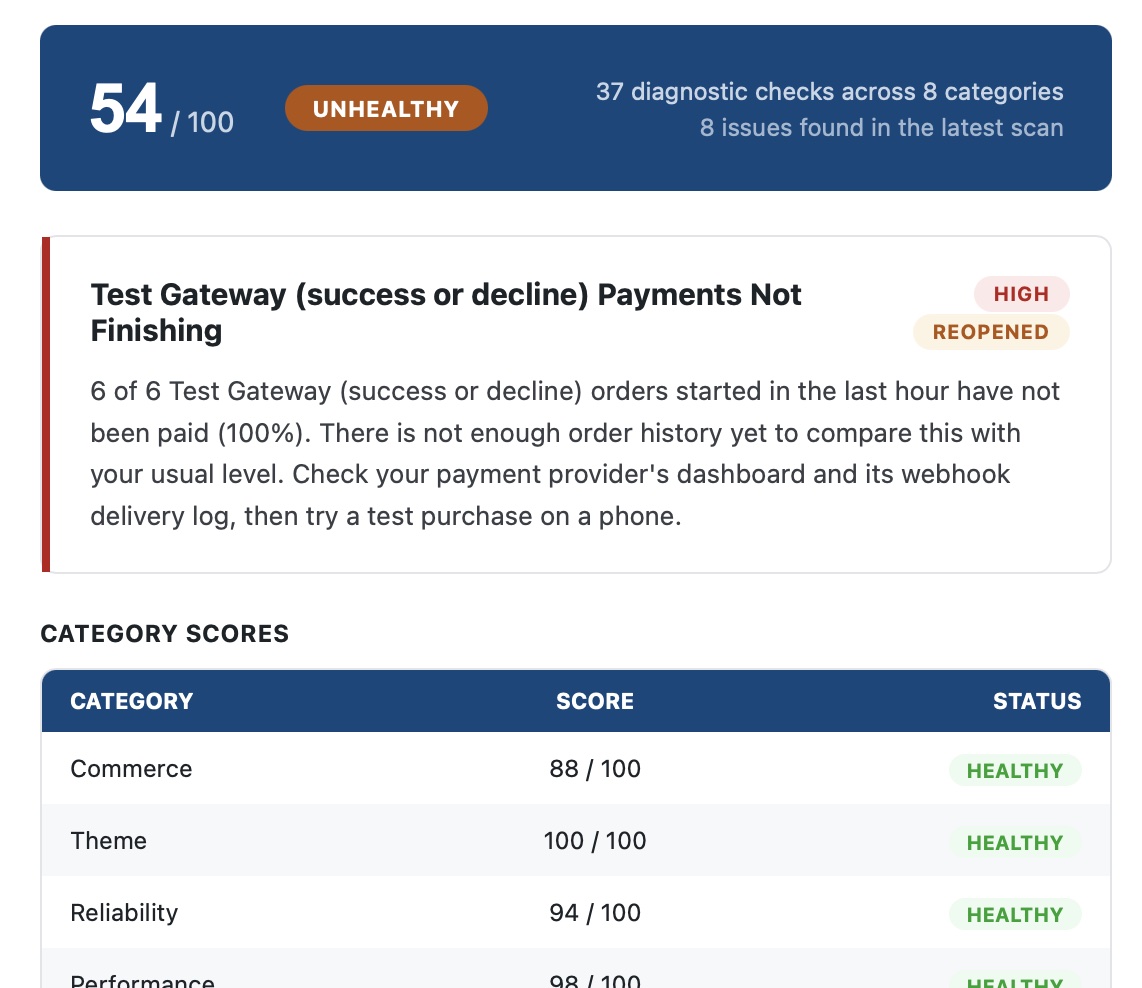
- A health score with plain-language next steps
- Nothing changes on your site, and no data is sent to us
Free on WordPress.org. Nothing in the free plugin is locked.
- Measures real-visitor checkout speed (LCP, INP and CLS) in the background
- Watches payments, checkout errors and plugin changes
- Emails you when something needs attention
PRO tells you what it finds. It does not fix problems for you.
Why KODENZO
Engineering Partner, Not Just a Developer.
Integration work is judged almost entirely by what happens when something goes wrong, not when everything goes right. Here's what that standard actually changes about how we build connections between systems.
-
Engineering First
Built for failure cases, not just success.
-
Protocol Discipline
REST, SOAP and OAuth2 done to spec.
-
Performance Focus
Optimised for real data volumes, not demos.
-
Real Business Experience
Solutions based on real integration failures seen before.
-
Long-Term Support
Monitoring beyond project delivery.
-
Transparent Communication
Clear updates and realistic expectations.
FAQ
Questions, Answered.
Straight answers to the questions we hear most often before an integration project starts — if yours isn't covered here, ask us directly.
CRMs, ERPs, payment gateways, shipping providers, 3PL and fulfilment providers, marketing platforms and most systems exposing a REST, SOAP or webhook-based API — including legacy systems with limited or undocumented APIs.
Yes — real-time sync via webhooks or direct API calls where the workflow needs it, or scheduled batch sync where it doesn't. We choose based on what the actual use case requires, not by default.
Every integration we build includes error handling, retry logic and alerting, so a failure is caught and recoverable rather than silent and undiscovered.
Yes — this is some of our most common work. We test against the live system directly to determine real behaviour when documentation is incomplete or outdated.
Yes — secure, documented endpoints that expose exactly what needs to be shared between systems, nothing more.
Yes — multi-platform coordination where several systems need to stay consistent with each other simultaneously, accounting for every pair potentially disagreeing.
Yes. Every integration can continue into long-term monitoring and support, so a broken connection is caught before it becomes a business problem.
Yes — we start with a technical audit of the platform's API and your current setup before building the integration.
No questions match your search.
Need Experienced API Integrations Engineers?
Whether you're building a new commerce platform, optimising an existing store, or solving a complex engineering challenge, KODENZO can help.